
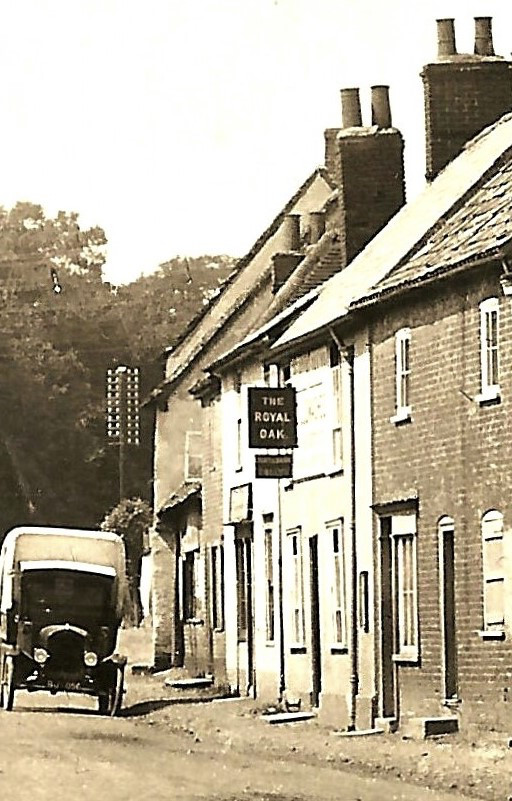
Like the White Elm, in Paper Mill Lane, the Royal Oak was a “Beerhouse” (see definition below). It was situated in The Street, in the row of houses between the Cooperative Store and Ravens Lane. The first record of it appears this newspaper report of 1869.
Suffolk Chronicle 24th July 1869
RIVAL KNACKERS – William Franklin, horse slaughterer, Offton, was charged with assaulting Alfred Binks*, at Bramford, on Tuesday 6th July. The complainant said on the 6th inst, he had occasion to stop at the Royal Oak, at Bramford, and while he was there, Franklin came in, swore at him, abused him very much and then struck him with his whip. Defendant denied the assault and said the complainant rode up and put his horse’s head in the cart. He told him to go away, as he wanted to have nothing to do with him. He called two witnesses who corroborated him. The complainant wished to have the case adjourned. The Chairman said it might be adjourned if he would pay the expenses of the day, 27s 6d. The complainant then said he would have it settled at once and the case was dismissed.
(*Alfred Binks, horse slaughterer, lived in Little Blakenham)
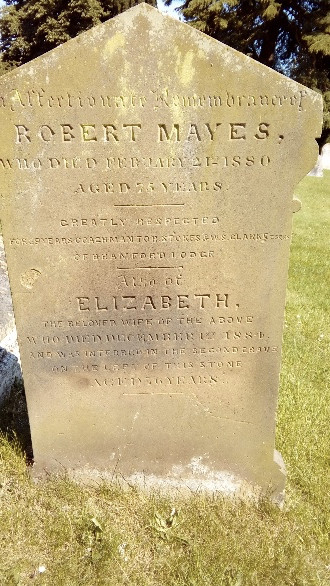
There is no record of it in the 1861 Census or earlier. In 1871 Robert Mayes is the innkeeper. Robert was born in Bramford in 1804 and in 1841 he was a Male Servant for William Clarke, The Lodge, Bramford. In 1851 a Groom for the Stokes family at The Lodge, and in 1861 Groom for William Clarke, The Lodge. Married Elizabeth Norris in Ipswich 1829. It’s reasonable to assume that Robert Mayes was the first landlord from the mid 1860’s after he finished working as a Coachman. Robert Mayes’s distinctive gravestone is in the churchyard and reads:
In Affectionate Remembrance Of
ROBERT MAYES
WHO DIED FEBRUARY 21ST 1880
AGED 75 YEARS
GREATLY RESPECTED
FOR 35 YEARS COACHMAN FOR R STOKES AND W S CLARKE ESQRS
OF BRAMFORD LODGE
In the 1881 Census, Robert’s widow, Elizabeth is described as a Beer Retailer. Living with her is her son, William Mayes and his family. William is employed as a Linen Draper. William seems to have taken over the business on the death of his mother, in 1884, as a newspaper report tells us that the licence was transferred from him to John Dedman in 1888. John and Ellen Dedman are listed in the 1891 Census at the Royal Oak.
By 1901 Henry and Emma Barfield had taken over but Henry died in 1907 leaving Emma to take over the pub which, by 1911, she is running with her daughter Ada and son Harry. The family are still there in 1921 but Harry is now a canteen assistant at Joseph Fison & Co in Paper Mill Lane.
Moving on to the 1939 Register of England & Wales, both Emma and Ada remain at the Royal Oak, but Ada is the manageress on behalf of Emma who is now in her 80’s.
Emma died in 1943 but who took over then we can’t be sure – we assume it would have been Ada for a while at least. Ada died in 1947 and her address at the time was in Cromer Road, Ipswich – the home of her brother Harry who was now the Canteen Steward at Fisons factory in Bramford.
In 1949 we know that the landlord was William John Garrod as he was involved in a court case about stolen petrol coupons as reported in the Suffolk Chronicle on June 17th 1949.
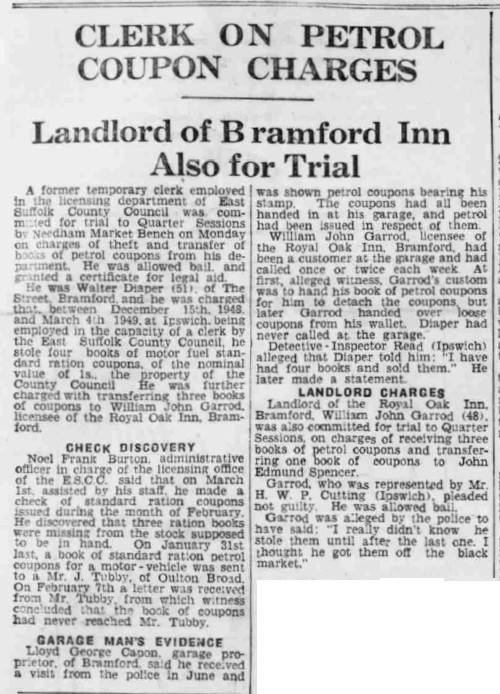
In the later trial, in July that year, William Garrod was sentenced to four months imprisonment. Walter Diaper had earlier been sentenced to nine months. (Suffolk Chronicle 22 July 1949) In that report it was stated that William Garrod had been the licensee for two years.
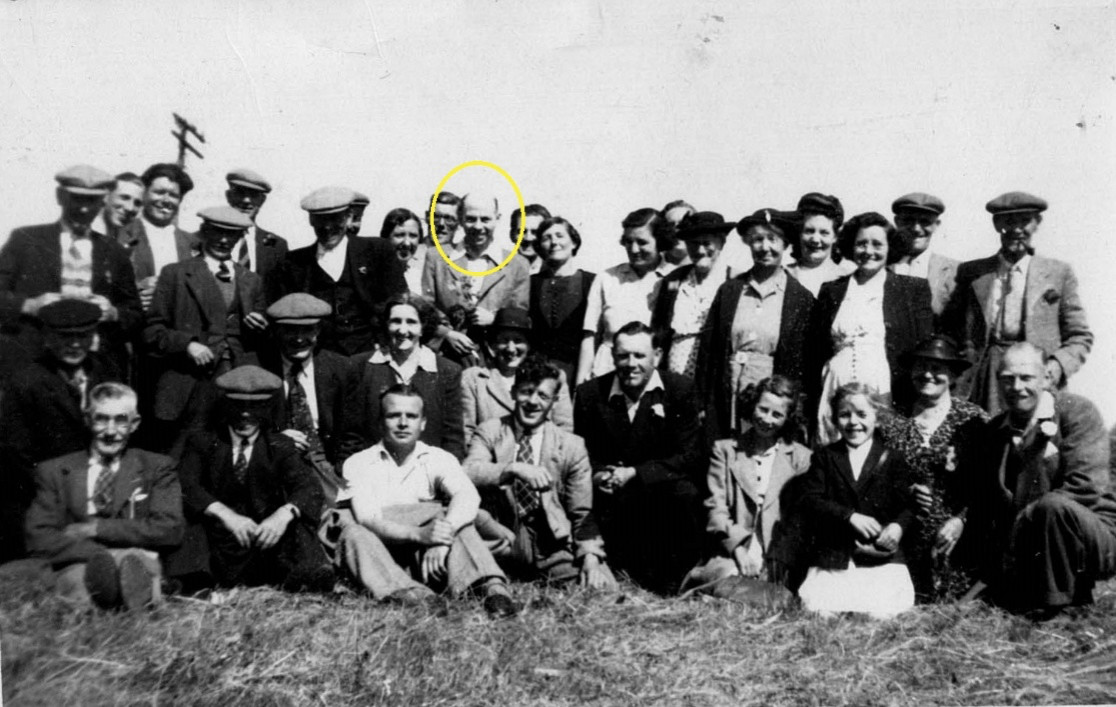
The next record we have is that Mr F T James was granted a “full licence” in 1954 (Suffolk Chronicle 12th February 1954). This picture is of an outing by pub regulars – date unknown. Freddie James is circled.
The Book of Bramford – (Halsgrove, 2003) records that Francis Partridge – late landlord of The Angel – took on the Royal Oak around 1960.
Footnote:
A Beerhouse was a type of drinking establishment created in the United Kingdom by the 1830 Beerhouse Act, legally defined as a place “where beer is sold to be consumed on the premises”. Public houses at the time were issued with licences by local magistrates under the terms of the Retail Brewers Act 1828 and were subject to police inspections at any time of the day or night. The proprietors of Beerhouses on the other hand simply had to buy a licence from the government costing two guineas per annum, equivalent to about £150 (in 2010). Until the Wine and Beerhouse Act 1869 gave local magistrates the authority to renew Beerhouse licences, the two classes of establishment were in direct competition.
The competition was intended to lower the price of beer and weaning the population off more alcoholic drinks – like gin.