Introduction
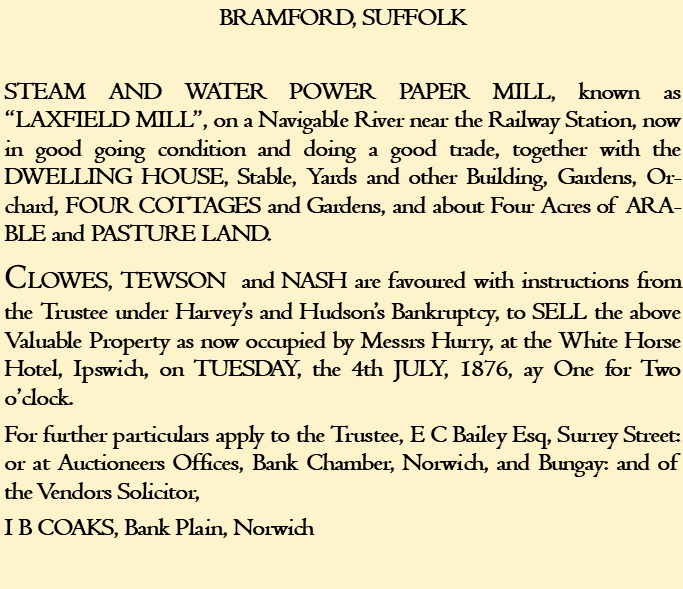
By the sixteenth century a fulling mill was established along what is know known as Paper Mill Lane. “Fulling” was a process in producing woollen cloth to clean and thicken it. The process was traditionally done by hands and feet but water powered fulling mills were introduced in the medieval period. By 1688 the mill had changed in use from cloth to making paper. In 1866 the mill was taken over by the Hurry family:
As recorded by Miss Edith Hurry
Grandfather and father probably started paper-making in Bramford in 1866 as father was married in that year and came to Bramford to live. Grandfather lived in Halstead where he had a paper mill, and another one at Grinstead Green for some time after 1866 as I have heard of father driving Billy, the horse, to Halstead to visit the rest of the family.
Previously grandfather had made paper at Long Melford in the mill now owned by Stafford Allen, the drug merchant.
The previous owner of the Bramford Mill was the maternal grandfather of the late Matthew Hale Webster by name. (An appropriate name for a man who made paper and also wove alpaca). When grandfather joined father at Bramford (apparently a Mr. Potter took on grandfather’s Essex mills) he lived in Whitton, where Mr. Marsden lived later. Then he occupied two cottages ‘up the hill’ and when he moved to Paper Mill Farm, Uncle Bob married and occupied these two cottages.
(Our brother Tommy, as a small boy used to walk alone over the fields to Whitton and take The Telegraph, which used to be delivered to Bramford Station by the newspaper train and brought to the Mill by one of the employees coming to work. Tommy was an extraordinary little boy -the ‘Hurry’ type. I remember him well, and the kindest brother in looking after me – three years younger than himself.)
Up to the time of our mill closing down, it was spoken of as the only Paper Mill in Suffolk (and we – the only Hurry’s at that time). But Ipswich had previously had a Paper Mill, on the site of the Water Works in Waterworks Street. It was probably handmade paper and was not in existence in my time. The Borough has perhaps some record of it. The Bramford Mill was named in the Paper Mill Directory as ‘Laxfield Mill’. That part of Bramford was known as Laxfield1 when a licence was granted to Cobbolds to build a beer-house there – “The White Elm”.
The original mill was, as far as my memory helps me, burnt down in February 1870 [10.7. 1869]; the year of my birth, and perhaps accountable for my unusual fear of fire. I have no recollection of what it was like from the few references ever made of it. The architect of the new building was Oliver Gibbons of the family of Gibbons at Benezet Mill. I heard him spoken of as a quiet young man, and his plans used to be in our house – it is many years since I saw them. Some bill-heads and printed stationery were also preserved with the sheets of brown paper on the top shelf of our big cupboard in the Parlour.
An early recollection is of a stack of flax just inside the Mill gate. This, with peat, chalk, and umber (from Devonshire) was one of the ingredients of papermaking.
These were the employees I remember:-
2 stokers who worked alternately, continuously from 12 am on Monday morning. (Do you remember their knocking father up in the middle of Sunday night regularly when they called for the keys?) Their weekend was from 8 pm (?) Saturday to 12 am Monday. The two, whom I remember were Holland and Randall.
2 engine men who attended to the tanks containing the pulp. They worked alternately day and night from 6 am on Monday to 2 pm Saturday. I remember Bloomfield & Caley. I may add that these men, who had been trained by father, worked there continuously. The only new faces were a boy or two and changed amongst the women who sorted the papers.
On the Rag Loft floor, sorting and chopping with a swiftly turning wheel fitted with knives, similar to a chaff cutter turned by machinery, were old Giles and two growing up boys. Grandfather had lost the tips of two fingers in this dangerous machine.
On the top floor were five or six, possibly more, women sorting papers. They sat on long benches with sieve-like tops to let the dust pass through.
The papers dropped through a trap door into the Engine room below.
The rags, after cutting, were passed into a big tank, soda added in big quantities, then covered with water, brought to the boil by a boiler near-by, this was the Boiler House. When sufficiently boiled, these rags were carried up into the Engine Room to make paper pulp.
When sufficiently pulped, the ingredients were poured down into the Machine House where two men were constantly employed. An important man was the “Paper Maker”, in my time Charlie Scrutton. He watched the pulp pass over wire gauze, over five hot cylinders, and other processes I do not remember, until it dropped onto a vertical shelf and cut off in sheets of required size by a mechanical cutter. It fell upright on to what looked like a large book rest. In front of it, on a high stool, was seated poor Jonah Pryke, a cripple, whose job it was to keep the sheets in order as they fell.
During Charlie Scrutton’s illness, father took his place and met with his terrible accident and nearly died from shock and burns.
The sheets of paper were moved on special barrows to the “Sorl” [Salle2]. There, two more men were constantly employed. In my time, Uncle Bob, who also acted as Clerk, and Amos Baskett. They folded the sheets into the size required and cut them on a scythe-like arrangement fastened horizontally to a post. Then pressing followed in the Presses turned by hand. In the same “Sorl” was stored paper wrapped and tied, arranged in stacks ready for disposal.
Uncle Will or somebody – a paper bag maker from Ipswich, was employed when an order for bags was received.
Other ingredients I remember were blue crystals, and a dye called magenta. These gave the colouring to blue and pink sugar paper.
Father used to say that papermaking was a profession, not a trade.
Grandfather told me that papermaking was introduced into the Hurry family by an American – a Papermaker who married the daughter of a Hurry then living either in Bungay or the district.
Two Hurry brothers who learnt the trade had a Paper Mill at Sheringham.
They brought up Grandfather who lost his father when he was young, and they gave him on his 18th birthday the “turnip” watch engraved with his name.
Several causes apparently contributed to the closing down of the Mill.
The mill and the farm were both run on the same capital. Money made in the mill was lost on the farm. A succession of dry seasons necessitated big purchases of coal for driving – as much as 2 tons a day was used.
Grandfather and father continued to make the same good quality of paper when the demand was for an inferior and cheaper kind. The removal of duty on foreign paper, which led to the importation of paper made from wood pulp in Austria and possibly other countries.
It might be as well to verify this statement by finding the date of the removal of duty. It did happen and led to the closing of many mills, but I am not sure whether it happened at the time of our failure.
But it is interesting to note that although Free Trade was so harmful to paper making, both father and grandfather were Free-traders. Judging from what I remember and my experience of life, I do not hesitate to say that four men like grandfather, father, Uncle Will and Uncle Bob could by united effort have overcome all the obstacles. Father has been spoken of as the only one who worked.
Additional notes
The mixture of rag pulp with paper pulp was in proportion to the strength of the paper required.
Two steel girders, costing £70 each, were necessary for support of the heavy first floor.
How much the Mason Mill contributed to the closing of ours I’ve no idea, but Mr. Eustace Mason said that they had lost I don’t know whether it was £20,000, £30,000 or £40,000 on the venture.
[1 Laxfield – the name existed in the 1782 Bramford Estate map as a field name close to the location]
[2 Salle – from the French for “room”. In the context of papermaking it was where the final product was stored and sorted. “The spelling “sorle” probably derives from the phonetic interpretation of the Suffolk dialect. Edith had probably only heard the word spoken.]
Biographical notes
Edith Sarah Hurry was born on the 3rd October 1870 in Bramford. She died on the 19th October 1956 in Ipswich and is buried in Barham Churchyard
In 1871 she is living with her family at Paper Mill House, Bramford and 1891 she is an Assistant School Mistress.
By 1921 she is the School Mistress at Barham School and in1939 at All Saints Road, Ipswich, a Retired School Teacher
Newspaper references to papermaking in Bramford
Ipswich Journal 29 March 1788
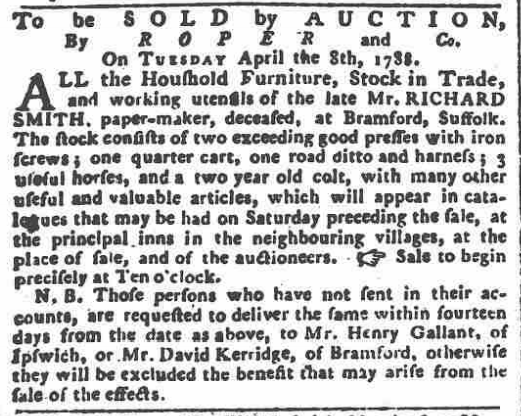
Ipswich Journal – Saturday 5 June 1802

Suffolk Chronicle – Saturday 5 June 1824

Norwich Mercury 14 July 1869
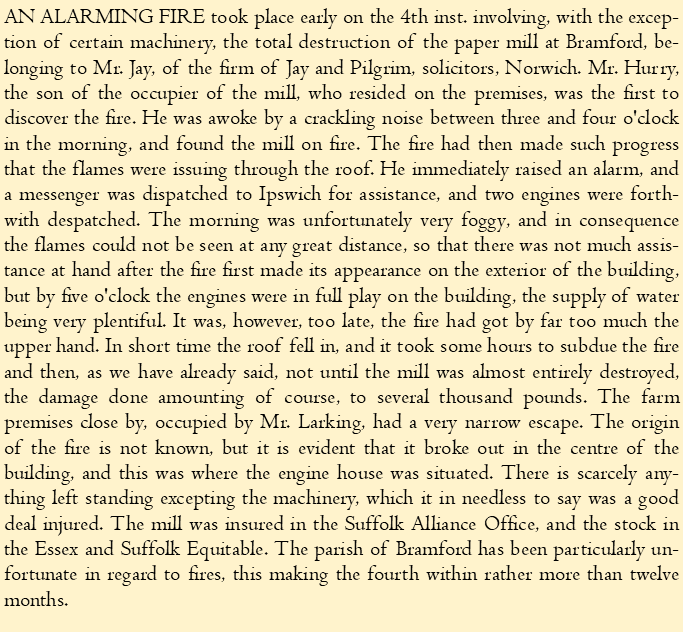
Norwich Mercury – Wednesday 28 June 1876