
From the Ipswich Journal, 23rd March, 1844
We are again compelled to defer several communications.
IPSWICH,
Saturday, March 23,1844.
MELANCHOLY AND FATAL ACCIDENT TO
LORD WILLIAM HILL.
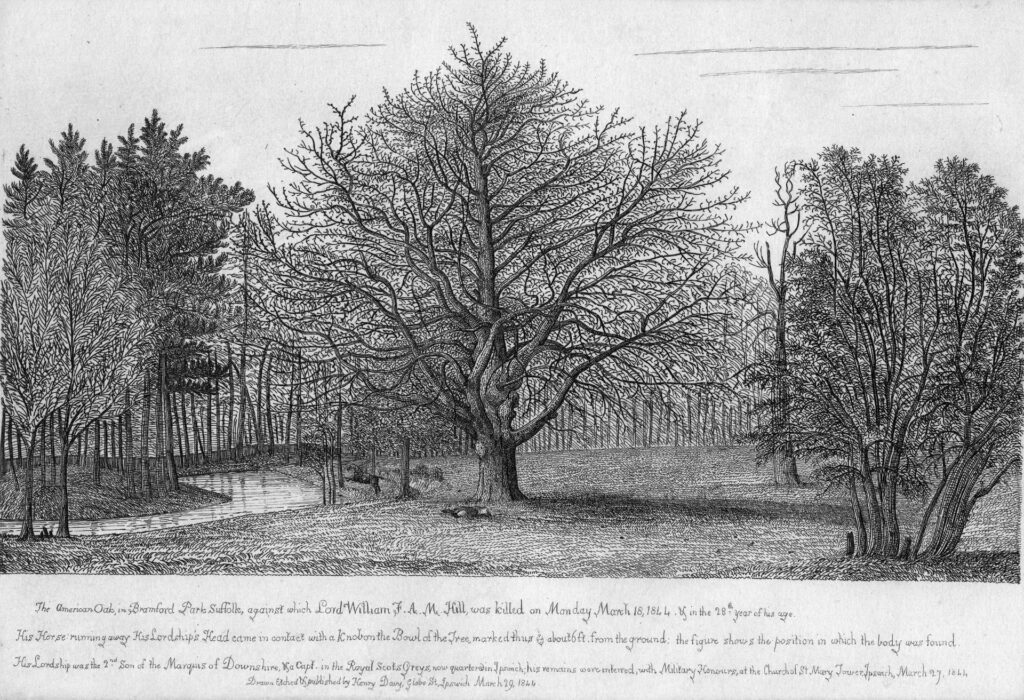
In the afternoon of Monday last a universal gloom pervaded the town of Ipswich, by the melancholy intelligence that Lord William Hill had met with his death at Bramford. Numbers of gentlemen to whom his Lordship was known with several of the Officers of the Royal Scots Greys, in which Regiment his Lordship held the rank of Captain, instantly set off for the above village, when the intelligence was ascertained, alas! to be too accurate. On a bed in a cottager’s house lay the lifeless remains of a nobleman who but three hours before, had left Ipswich in all the buoyancy of youthful health and vigour, to participate in his favourite recreation of a stag-hunt. It is well known that, at Bramford, the Officers, not only of the Scots Greys, but of preceding Regiments, have for some time past, kept an excellent pack of stag hounds, in the management and care of which Lord William Hill, who was a genuine sportsman of the old English school, took a warm interest. In addition to this circumstance, the neighbourhood of Bramford was expected to be the scene of the next Grand Steeple Chase and from the endeavours made by Lord Hill, and his brother Officers, and other gentlemen, to get up the sports in the best possible style, Bramford had latterly become a sort of rallying point for the lovers of the turf. On Monday, it was appointed that the Staghounds should have a run. Lord William Hill and other gentlemen left Ipswich in the morning at the usual hour. The time appointed for uncarting the stag, was about half-past twelve. About this time, Lord W. Hill, attended by his servant, was in Bramford Park, the domain of the Dowager Lady Middleton. The horse which his Lordship had selected to ride, was a fine and noble animal, but unfortunately possessed of a very vicious temper, which rendered him unmanageable at times, even in the hands of Lord Hill, though his Lordship was regarded as one of the best riders in England. The servant, we understand, intimated to Lord Hill that the horse appeared to be more vicious than ordinary, but nothing deterred, his Lordship mounted the animal, being very anxious to have him in good training, as he was intended to start at the Grand Military Steeple Chase, which is appointed to take place in the course of the ensuing spring, at Southampton. His Lordship had no sooner taken his seat in the saddle with the bridle in his hand, than the horse, which his Lordship mounted near Bramford Hall, darted off with terrific speed down the park. The only parties who witnessed the starting were his Lordship’s servant and the gardener of Lady Middleton. It was soon seen that the horse was under no control, for having what is termed a hard mouth, Lord Hill’s efforts to keep him in check were rendered nugatory, and the worst consequences were apprehended, and they were too soon realized. The horse continued at full speed down the sloping grounds, in the direction of a pond and a large tree. In the endeavour to avoid the pond, the unfortunate nobleman incurred only greater danger, and the horse continuing his uncontrolled course, brought his Lordship in collision with the tree, and he instantly fell lifeless to the ground. It appears that, up to the moment his Lordship struck against the tree, he had a full sense of the danger he was about to encounter. Aware that a collision with the tree must be attended with fatal consequences, his Lordship at first endeavoured to incline the horse’s head to the right, but the vicious animal appeared determined to pass the tree on the left, and even to run his Lordship against the trunk. As a last resort to avoid the danger, his Lordship very dexterously inclined himself forward in the saddle, his head being nearly close to the horse’s neck, but just as he came to the tree, so limited was the space through which he had to pass, that his head was brought in dreadful collision with a projecting arm from the upper part of the trunk, and the lamentable catastrophe ensued. His Lordship’s servant and the gardener at Bramford Hall, immediately ran to the spot. He was found lying upon his side about a yard from the tree. After untying his handkerchief and unbuttoning his waistcoat, the deceased was conveyed in a chair to the gardener’s cottage and placed on the bed. Beyond a gurgling in the throat, there were no indications of breathing, or any appearance of life. The utmost despatch, however, was used in sending for surgical assistance and Mr. Bartlet and Mr. Mumford, surgeons, Ipswich, and Mr. Sawer, surgeon, Bramford, with the surgeon of the Scots Greys, were soon in attendance, but as life was found to be extinct, surgical aid was of no avail. The Rey. George Naylor, the vicar of Bramford, was also promptly in attendance upon the unfortunate nobleman. Thus have the gallant Scots Greys been suddenly deprived of a valuable officer, the sporting circles of a most ardent and honourable supporter of the chase, and the country of a universally esteemed and beloved Nobleman. Upon examining the body of the deceased previous to the inquest being held, it was found that his left leg was injured by having come in contact with the trunk of the tree; and blood flowed from the top of the head, from a wound in the scalp, produced by the branch which he had endeavoured to avoid. No regular post-mortem examination was deemed necessary, but from what we can learn, there was no fracture of the skull, or any extraordinary appearance of violence. So dreadful was the shock, it appeared to be the opinion of those qualified to judge, that the immediate cause of death was concussion of the brain, as his Lordship was not known to move or breathe after his fall. Upon inspecting the scene of the catastrophe the hat of the deceased was found to be crushed nearly flat and broken, whilst particles of felt adhered to the projection from the tree, The traces of the horse’s hoofs over the turf also indicated the fearful pace at which he was going when the collision took place, and that it had been physically impossible for his Lordship to control the animal. In the afternoon an inquest was held on the body at the Angel Inn, Bramford, before Mr. Gross, Coroner, and a respectable jury summoned from the village. Before evidence was taken, the jury as usual took a view of the body, and then of the spot where the accident occurred; and this melancholy part of their duties having been performed, the body was placed in a carriage, and conveyed to Ipswich Barracks, followed by several officers of the Scots’ Greys, who appeared to be labouring under the most poignant emotions. Upon the return of the jury to the Angel Inn, it was not deemed necessary to examine any other witness than the gardener, the Coroner dispensing with the testimony that could have been given by Lord Hill’s servant, who had been ordered to proceed instantly to London as the messenger of the afflicting tidings to the family connections of his Lordship. The evidence given was that of, William Wightman, gardener, of Bramford Hall, who deposed, that about half-past 12 o’clock, he saw the deceased get on his horse and gallop down towards the tree adjoining the pond. He saw the servant get off the horse, and saw his Lordship get on. The horse went towards the tree. Witness’s eye followed the horse, but he did not see his Lordship fall, as the tree was between them. He saw no other person near the place. Observing the horse without its rider, he looked and saw his Lordship’s red coat. He then jumped over the fence and ran towards deceased, who was lying on his side. Witness lifted him up, untied his handkerchief, and unbuttoned his waistcoat. Another person, he believed Lord Hill’s servant, then came up. They took the deceased in their arms and carried him to witness’s cottage. He did not at once conclude that his Lordship was dead; but, seeing that he was very much injured, he asked his servant to go for a doctor. Witness carried him part of the way himself; and witness’s wife and another came with a chair. They then took him into the house and put him on the bed. During this time, he saw no appearance of life; no indication of breathing, and the deceased was in the same state when lifted on the bed. There was a kind of gurgling in the throat. The distance from the place where witness stood when the accident occurred, and the tree, was not more than 500 yards. Not a minute and a half elapsed between the accident and his Lordship being taken up. Witness observed no wound or mark till he laid him down. He then saw a little blood among the hair. He never saw a dead person before. His Lordship’s eyes were both open, so was his mouth. At first witness thought he was stunned. When witness found his Lordship, he was about a yard from the trunk of the tree. He had seen his Lordship gallop in the park frequently, but never saw him ride so fast before the horse was in full gallop. The distance from the place where his Lordship got on the horse, to the tree, was about 400 yards. He did not go in a direct line. Did not lose sight of his Lordship from his mounting till he got to the tree. His Lordship went as he usually did; but it seemed that when he got near the tree the horse became unmanageable. Witness thought his Lordship died instantaneously. A juror observed that his Lordship was pulling the horse to the right, and he wanted to go to the left. Witness did not think that the horse kicked his Lordship. Mr. Mumford, Mr. Bartlet, and Mr. Sawer, surgeons, were in attendance, but the jury thought it unnecessary to examine them. Verdict, “Accidental Death.” The deceased nobleman was the second son of the Marquis of Downshire, a family of great wealth and influence in the county of Down, Ireland. On Wednesday, the Earl of Hillsborough, the deceased’s eldest brother, arrived at Ipswich, preparatory to the arrangements for the funeral. These, however, we understand, cannot be completed until the arrival of the bereaved parent, who, at the time we write, is hourly expected. Nothing is known definitively as to where the interment will take place, but it is expected that the body will be removed for interment in the family vault in Ireland. Numbers of people have visited the fatal spot. The tree, which has a remarkably picturesque appearance, has been sketched by Mr. H. Davy, artist of this town, preparatory to an etching for publication.
ANOTHER ACCIDENT FROM THE SAME HORSE
A few minutes after Lord Hill was observed to fall to the ground, the horse, which was running loose in the park, was caught by a young man, named Joseph Palmer, about eighteen years of age, and son of a widow woman with nine children, residing at Bramford. Palmer instantly mounted the animal, intending to ride him out of the park, but the horse being still excited and unmanageable, Palmer was soon thrown with great violence, and, in falling, his head came in contact with the park palings. He was immediately conveyed to his mother’s cottage, when he was attended by Mr. Mumford and Mr. Sawer. It was found that he had sustained some very severe injuries especially about the head, besides being much bruised about the body, but no bones fortunately had been broken, He lay for some time in a most precarious state, but with the skilful remedies applied he was pronounced much better on Thursday, and hopes are entertained that, in the course of a short time, he will be convalescent. We have much pleasure in recording that nothing could exceed the kindness displayed by the Officers of the Scots’ Greys towards the young man: and as a token of their sympathy for the mother, they ordered that no expense should be spared in the means employed to restore her son to health.
This obituary appeared in the Gentleman’s Magazine of May 1844
LORD WILLIAM HILL.
March 18. At Bramford Park, near Ipswich, in his 28th year, Lord William Frederick Arthur Montague Hill, Captain in the Royal Scots Greys, and Aide-de-camp to the Lord Lieutenant of Ireland.
His Lordship was born July 10, 1826, the second son of Arthur, present and third Marquess of Downshire, by Lady Maria Windsor, eldest daughter of Other-Hickman 5th Earl of Plymouth. He entered the 43rd Light Infantry in the spring of 1834, at Waterford; and accompanied that regiment to New Brunswick, in the month of June, 1835. He was also present and marched with it through that arduous, difficult, and unprecedented march (except the 104th Regiment in 1814), through the portage from Fredricton to Quebec, during a Canadian winter, between the 11th and 28th December, 1837. His commission as Lieutenant was dated 21st of October, 1836; but he remained and did duty with the 43rd until the summer of 1839, when he joined the Scots Greys.
Lord William Hill met his death in Bramford Park, the seat of the Dowager Lady Middleton, while proceeding to the hunt. Having mounted his horse about half-past twelve, his lordship seemed to have dashed with his well-known boldness down the park. At the bottom of a hill there is a pond, and in endeavouring to turn the horse so as to avoid it, the animal, which was in the highest state of excitement, bore his lordship with so much violence against a large tree, as to knock him from his seat, and cause instant death. The horse was shortly after-wards mounted by a youth named Palmer to ride him out of the park, but the horse was in such an unmanageable state that he was almost instantly thrown off; and, his head coming in contact with some palings, he received such serious injuries as to cause his death also in a few hours, At the general desire of the regiment, conveyed to the Marquess of Downshire through Lieut.- Colonel Clarke, commanding the Scots Greys, the funeral took place at Ipswich instead of the family burial-place at Easthampstead, Berks.
The Marquess of Downshire, Marquess of Salisbury, Earl of Hillsborough, Lord Sandys, Lord Edwin Hill, Viscount Holmesdale, Hon. R. H. Clive, M.P., Colonel Clive, Capt. the Hon. N. Hood, Sir W. Middleton, Bart. &c., attended the funeral; and the body was interred, with all military honours, at the church of St. Mary Tower.
Notes:
1 The gardener, William Weightman, lived with his family in Bullen Lane. (1851 Census)
2 Joseph Palmer was the son of Mary Ann Palmer – the family lived in The Street (1841 Census). The Gentleman’s Magazine obituary contradicts what happened to him after his accident. He certainly appears to have survived more than a “few hours” according to the report in the Ipswich Journal. Research so far has not been able to conclude whether he survived his injuries or not.
3 Lord William Hill was, as stated, buried in the churchyard of St Mary-le-Tower in Ipswich and a memorial tablet was erected in the church.
https://www.flickr.com/photos/norfolkodyssey/52567197308/in/album-72157672763957265/