
The story behind a name scratched in lead
In 2006 a major restoration project was carried out on the timber and lead spire of St Mary’s Church, Bramford. Before the lead was stripped off photos were taken of the “graffiti” that had been scratched into the lead by visitors over the years.
The route to the top is not an easy one – it involves a climb up the ancient and worn spiral stone staircase to the bell chamber – this accessed by a low opening in the tower wall. The journey is completed by a climb up and over the bell frame, a short vertical ladder to a low door let into the side of the spire base and out onto the narrow “battlements”.
However difficult it might have been, many have made the journey over the years – more so since it has become common to open the tower for visitors on special occasions.
The “graffiti” consists of names, initials – often accompanied by dates, outlines of hands and feet – even pictures of ships and outlines of workman’s tools. The latter indicating that some who went up there did so for essential maintenance and had left their mark.
Some of those inscribed names of village residents and workmen have been traced in records but one particular name stood out.

7471
F W Gephart
Australia 2 Btn
19=7=1919
A VISITOR FROM AUSTRALIA
So, a visitor from Australia – but who was F W Gephart? The surname is not one associated with the village and is German in origin. The date is shortly after the end of the First World War and the “7471” could be a soldier’s service number – especially associated with “2 Btn” – a common way of abbreviating “2nd Battalion”.
Using the power of the internet and social media it soon became clear that 7471, Private Frederick William Gephart served in the 2nd Battalion, Australian Infantry Force (AIF) in the First World War. After the Armistice was declared, in November 1918, Pte Gephart was brought over to the UK for rehabilitation following exposure to gas and bouts of illness. While stationed in London he was given leave between the 14th and 29th of July 1919 – dates which neatly bracket that scratched into the lead.
The next question is, of course, why did Pte Gephart make the journey from London to a little Suffolk village on the outskirts of Ipswich while on leave?
For the answer to that we needed to look closer at his family background. Fred, as we shall now call him, was born in Moama, New South Wales, on the Murray River and the border with the state of Victoria. His father was Daniel, and his mother was Emily (née Kinsey) and immediately his mother’s maiden name was something more familiar – there being a family of that name in the village before the war. Could this be the link?
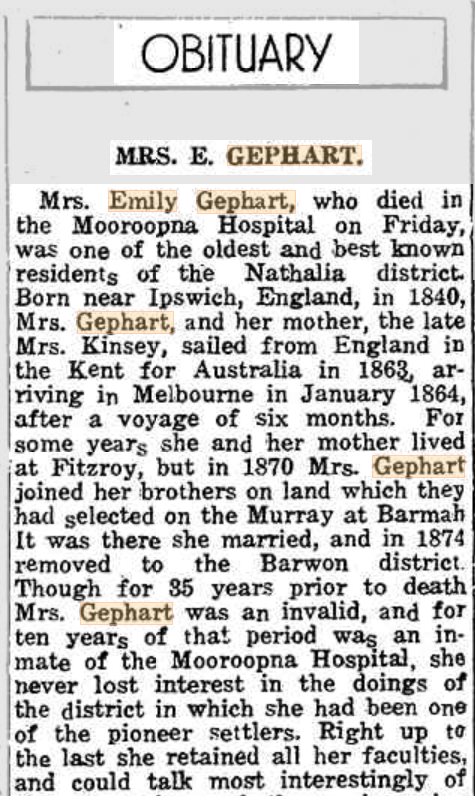
A further search of the wonderful (and freely accessible) Australian newspaper archives revealed an obituary for an Emily Gephart who died in 1935. The unusual surname was a key factor in tracking this down, and it clearly confirms Fred’s mother’s origin as well as one of her sons being “Mr F Gephart”.
Reverting back to UK records we find Emily Kinsey was born in nearby Offton in 1840 to William and Mary Ann Kinsey.
In 1851 the family are in Brettenham, William is a shopkeeper, and the family now comprises William Jnr, (born in Battisford, c1837) Emily, (born in Offton, 1840), Henry, (born Offton, c1841) and Albert, (born in Brettenham, c1844).
William Snr died in Brettenham on the 5th January 1864, so it seems, from the information in the newspaper article, that Mary Ann and children (except for William Jnr) had left for Australia before he died.
No direct link has been found with his mother’s family and the Kinsey family in Bramford. A possible very distant relationship might exist but may not have been apparent when Fred visited the area. A possible explanation of his presence in the village is that he just wanted to visit his mother’s birthplace at Offton while in the UK, and Bramford Railway Station would have been the nearest stopping off point. In uniform, and with his “wound stripe” on his left sleeve, it would be gratifying to think that he would have received every assistance from residents which might have included transport, accommodation, and a “tour” of the church tower!

WAR RECORD
Fred enlisted in Dubbo, NSW, on the 22nd March 1917 and described at the time as a farmer. After training, he left Australia on the 14th July 1917 and arrived at Liverpool on the 28th August. After more training in the UK, he crossed to France on the 2nd March 1918. His record shows that he suffered some ill-health including mumps, ‘flu, and bronchitis. While in the front line near the village of Proyart, just south of the Somme River, his battalion was bombarded by gas shells while in position in Robert Wood:
2nd Battalion AIF War Dairy
24th August 1918
“B Coys position heavily shelled by gas shells and suffered several casualties.”
Fred was one of the casualties, and after treatment returned to his unit on the 16th October 1918. However, another bout of ‘flu followed on the 7th November leading to another stay in hospital followed by transfer to England on the 6th December 1918.
Fred eventually returned to Australia on the 26th October 1919 where he married Mary Shanks in 1931 and died in 1958 in Mernda (a suburb of Melbourne).
A commemorative plaque to him was installed at the Fawkner Memorial Park, Melbourne, Victoria, where he is buried.

Footnotes:
1 Newspaper clip from the Shepparton Advertiser 29th May 1935
2 Portrait and picture of memorial plaque from the Australian War Memorial website where more information about Fred can be found. https://www.awm.gov.au/collection/C1126416