
John Minter Morgan was baptised in St Bride’s, Fleet Street in the City of London on the 19th June 1782. His parents were John and Biddy Morgan. John Snr’s father was George Morgan of Bramford. The Morgans were prominent farmers in Bramford and very involved with the church – many generations serving as Churchwarden. (The first “George Morgan” is listed in 1757 as Churchwarden.) John Morgan Snr married Biddy Minter on the 16 April 1781 in Claydon (Biddy died in 1823 and the couple are buried in Bramford churchyard). John Minter inherited a substantial fortune from his father in 1807 which enabled him to devote his life to philanthropy.
John Minter Morgan’s connection to the village is clear and from much of his writings (see his biography below) we can deduce that he was very keen on the subject of educating the working classes. It’s not unreasonable to suppose that what was happening in the village, with the Rev George Naylor’s “School of Industry”, (as referred to in a needlework sampler produced in 1825) would have met with John Minter Morgan’s approval.
The sampler was created by Sarah Garrard and turned up in the USA – the History Group provided information to the researchers from the Needle Work Press. More details about Sarah Garrard here.

The physical location of the school has not been determined exactly but was probably in the Parish Room which stood at the bottom of Ravens Lane (next to Verandah Cottage). This building used to belong to the Church but evidence of when this was built is lacking and it may have been a later development. It was demolished after being damaged in the storm of 1987. A reference in the Churchwardens Accounts in 1767-68 records a glazier’s bill for 18 shillings and 3 pence for the “School House” which pre-dates George Naylor’s incumbency (1795 – 1854). Robert Hudson was vicar at this time (1760-1785). However, this does establish that a school, run by the church, was operating in the village at the time that John Minter Morgan’s grandfather was a churchwarden. In addition to this, John Minter Morgan’s sister, Elizabeth, married Robert Mumford, another wealthy farmer, who built The Grove, in Paper Mill Lane. (Robert William Mumford was churchwarden alongside George James Morgan in 1838/39. He had married Elizabeth in 1830)
John M Morgan’s death notice – London Evening Standard 29th December 1854
On the 26th instant, at his residence, Stratton-street, Piccadilly, of paralysis, John Minter Morgan, Esq, in his 73rd year. His whole life was one of philanthropy and devoted to the amelioration of the condition of the poor and ignorant, his last act of charity being an instruction that the children of the National Orphan Home at Ham common of which he was the founder, should be amply provided with a Christmas dinner at his expense.
It is not surprising, therefore, that following his death on the 26th December 1854, his will contained bequests to the village church and school. An organ that was in his house in Ham Common (now in the London Borough of Richmond on Thames) was bequeathed to the church along with a sum of money (£50) to transport and install it.
This was installed in the church in 1855, as advertised in the Suffolk Chronicle of the 28th April that year:
BRAMFORD CHURCH
THERE will be DIVINE SERVICE in this Church on
THURSDAY, May 3rd, 1855, at 3 o’clock, when
THE ORGAN
Bequeathed to this Parish by the late John Minter
Morgan, Esq, will be OPENED with CHORAL SERVICE.
*On this occasion a SERMON will be preached by
the Rev RICHARD H GIBSON MA and a Collection made
on behalf of the Building Fund of the Burstall National School.
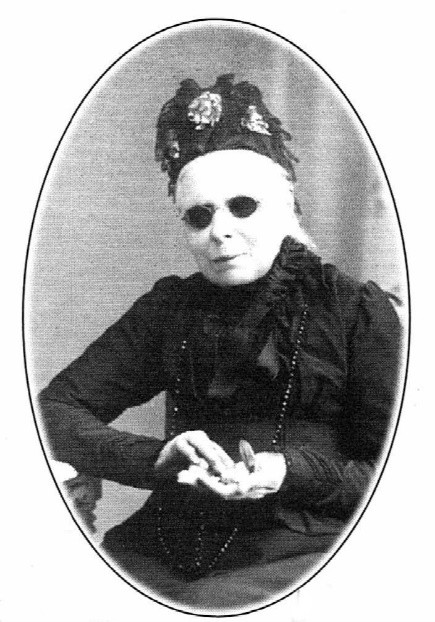
Eliza Mee
It was this organ that Eliza Mee (1825 – 1912), of Bramford, (pictured left) although blind from birth, played until her retirement in 1890. In an article published on the occasion of her retirement (Ipswich Journal 15th November 1890) it was said that John Minter Morgan requested that she be the organist “so that she might be helped to gain a livelihood”. Her first service as organist was on the 6th May 1855 and her last on the 12th October 1890. In an article about renovations to the church (The Ipswich Journal, 13th September 1862) it was stated that a new organ “has been erected within three years” – indicating that the donated instrument had been replaced.
In addition, John Minter Morgan left to “the Minister and Churchwardens for the time being of Bramford aforesaid for the use of the Church Poor School at Bramford aforesaid, two hundred pounds” – a considerable amount of money.
John Minter Morgan from the Dictionary of National Biography:
MORGAN, JOHN MINTER (1782-1854), miscellaneous writer, was probably born in London in 1782. His father, John Morgan, a wholesale stationer at 89 Ludgate Hill, and a member of the court of assistants of the Stationers Company, died at Claydon, Suffolk, on 1 March 1807, aged 66. The son, inheriting an ample fortune, devoted himself to philanthropy. His projects were akin to those of Robert Owen of Lanark [q. v.] but were avowedly Christian. His first book, published in 1819, entitled Remarks on the Practicability of Mr Owen’s Plan to improve the Condition of the Lower Classes, was dedicated to William Wilberforce, but met with slight acknowledgment. His next publication was an anonymous work in 1826, The Revolt of the Bees, which contained his views on education. Hampden in the Nineteenth Century appeared in 1884, and in 1837 he added a supplement to the work, entitled Colloquies on Religion and Religious Education, In1880 he delivered a lecture at the London Mechanics’ Institution in defence of the Sunday morning lectures then given there. This was printed together with A Letter to the Bishop of London suggested by that Prelate’s Letter to the Inhabitants of London and Westminster on the Profanation of the Sabbath. Morgan presented petitions to parliament in July 1842 asking for an investigation of his plan for an experimental establishment to be called the Church of England Agricultural Self-supporting Institution, which he further made known at public meetings, and by the publication in English and French in 1845 of The Christian Commonwealth. In aid of his benevolent schemes, he printed Pestalozzi’s Letters on Early Education, with a Memoir of the Author,’ in 1827; Hannah Mores’ Essay on St. Paul, 2 vols. 1850; and Extracts for Schools and Families in Aid of Moral and Religious Training, 1851. He also edited in 1849 a translation of an essay entitled Extinction du Pauperisme, written by Napoleon III, and in 1851 The Triumph, or the Coming of Age of Christianity, Selections on the Necessity of Early and Consistent Training no less than Teaching. In 1850 he reprinted some of his own and other works in thirteen volumes under the title of The Phoenix Library, a Series of Original and Reprinted Works bearing on the Renovation and Progress of Society in Religion, Morality, and Science; selected by J. M. Morgan. Near his own residence on Ham Common he founded in 1849 the National Orphan Home, to which he admitted children left destitute by the ravages of the cholera. In 1850 he endeavoured to raise a sum of 50,000l to erect a Church of England self-supporting village, but the scheme met with little support. He died at 12 Stratton Street, Piccadilly, London, on 26 Dec. 1854, and was buried in the church on Ham Common on 3 January1855.
Besides the works already mentioned, he published:
1. The Reproof of Brutus, a Poem,1830.
2. Address to the Proprietors of the University of London [on a professorship of education and the establishment of an hospital],1833.
3. A Brief Account of the Stockport Sunday School and on Sunday Schools in Rural Districts, 1838.
4. Letters to a Clergyman on Institutions for Ameliorating the Condition of the People, 1846; 3rd edition, 1851.
5. A Tour through Switzerland, and Italy, in the years 1846-1847,1851; first printed in the Phoenix Library, 1850.
[Gent. Mag. April 1855, pp. 430-1; Illustr. London News, 24 Aug. 1850, pp. 177-8, with a view of the proposed self-supporting village.]
G.C.B.