
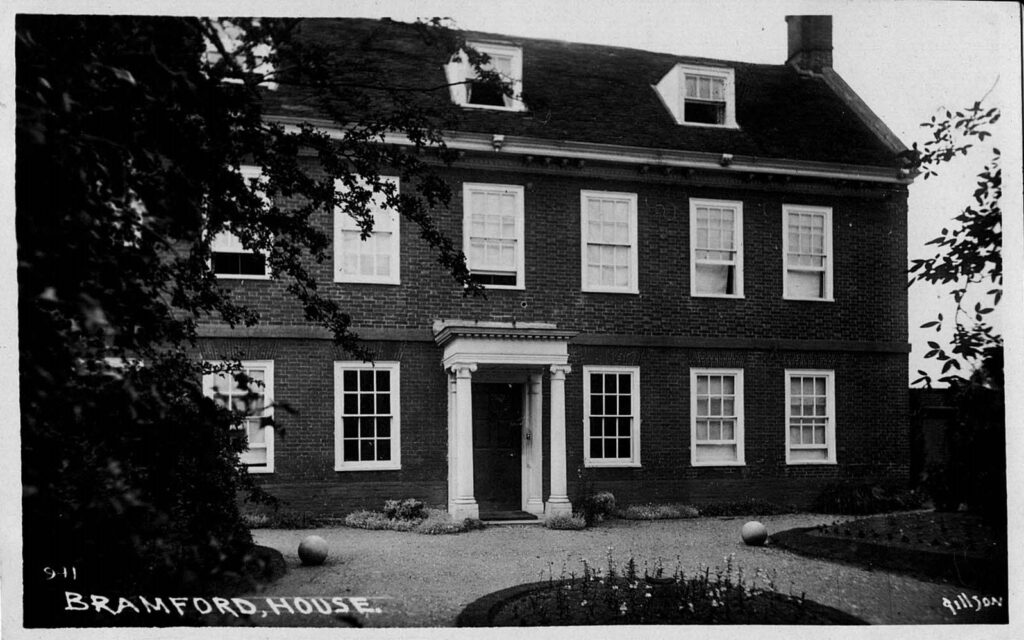
BRAMFORD HOUSE
Built in 1693/4 but may have an earlier core. The land along with several other buildings, including a malt house, was purchased from the Alston family of Lovetofts Hall in 1659 by John Warner.
Through the late 18th and early 19th Centuries it remained in the hands of the Leggatt family. The last member of the family, Martha Penelope Leggatt died in 1902.
Martha Penelope Leggatt 1829 – 1902
By Jenny Burgon – grand-daughter of Quentin Fullbrook-Leggatt

Martha Penelope Leggatt was born in 1829 and baptised at St James, Clerkenwell on 16 November 1829. Her parents were then living at Upper Charles Street, Clerkenwell. Her father was a warehouseman.
Martha’s baptism record from St James, Clerkenwell:

The year after her birth, both her paternal Leggatt grandparents, John Leggatt and Ann Hoare, died in Reading, Berkshire, her father’s birthplace. Her maternal grandmother, Sarah, born in Reading, had died in Ipswich two years before Martha Penelope was born. Her maternal grandfather, William Meek Marston [see note], born in Smallburgh, North Norfolk, was a woollen draper and a merchant banker at the Butter Market in Ipswich. He married Sarah Leggatt at St Lawrence’s Church, Ipswich on 13 May 1778. Thirty-one years later this church was the venue for Martha’s parents’ wedding. It seems probable her paternal grandfather, John Leggatt, and her maternal grandmother, Sarah Leggatt, were related.

St James’s Church, west end. Drawing by John Coney, 1818
Martha had an older brother, John William, and an older sister, Sarah Ann. When she was 10, her 17-year-old sister died at the family home, 18 Duncan Terrace, Islington, of “affection of the head”. A modern explanation of this diagnosis says it can range from minor injuries to serious conditions like a brain tumour. Her maternal aunt, also Sarah, died of breast cancer in 1842, aged 51. No address was given on her death certificate which may be because the previous year the 1841 census described her as a patient at the Belle Vue Lunatic Asylum. Victorians thought mental illness was hereditary and should be hidden. Such attitudes may offer an explanation that neither Martha Penelope nor her brother married. Her mother’s brother, William Leggatt Marston married a widow at the age of 38 but had no children with her. He died, aged 51 in Ipswich in 1843, having taken over his father’s drapery business in the Butter Market, Ipswich in 1824, sixteen years before his father’s death.
Martha’s father had one sibling, his sister Penelope (1791-1865) who spent all her life in Reading. In 1851 she was living in Southampton Street and is described as a “proprietress of houses and a fund holder”. By 1861, still in the same house she was a fundholder. She died unmarried in 1865, choosing her nephew and niece at Bramford House, near Ipswich, Suffolk, as executors.
In 1851 Martha, her brother and parents were living at George Yard, Lombard Street in the City of London. By 1859, the family had moved to Bramford House, northwest of Ipswich, where her father died. Her mother died there in 1872 and her brother in 1897. She continued to live in the house for a further five years, dying there in December 1902, the only descendent of her four grandparents. Her obituary reported “…she was well known and very much esteemed by all the parishioners and took great interest in Church and parochial work generally at Bramford and she will be very much missed by the inhabitants generally.” This was evidenced ten years later when the organist at Bramford Church, Miss Eliza Mee, died and her obituary reported: “though blind during her whole life she had for 35 years been the organist at Bramford Church. She owed her success to the teaching of the late Miss Martha Penelope Leggatt”.
From Suffolk Houses: A study of domestic architecture, by Eric Sandon FRIBA, 1977:
Bramford House was listed on 9.12.1955 as a Grade II* House, probably built c.1693 with possible earlier core and C18 alterations. Double-pile plan. 2 storeys and attics, 7 windows. Orange brick with parapet gables incorporating chimneys. Band at 1st floor level, above which the Flemish bond walling has burnt headers. A fine wooden eaves cornice has groups of 3 and 4 console brackets and a frieze enriched with egg and dart ornament. Ogee guttering with large lion-head waterspouts. Plain tiled 2-span roof. Flat roofed dormers with C19 sashes. Sashes with flat arches of gauged brick and flush frames with small-pane sashes. Entrance door with 6 fielded panels. The Roman Doric portico porch is probably a late C18 addition; it has a flat entablature on a pair of circular columns. An original staircase has barley-sugar twist balusters. Several rooms have good original fireplaces and panelling.
When Miss Leggatt died, she left an estate valued at £71,545 gross (about £11 million in 2025). She left a number of generous legacies to people and institutions in both Bramford and Reading and the bulk of her estate to Charles Fullbrook on the condition that he took the name Leggatt. The families had probably been friends for a generation or more and she may have been influenced by the fact that Charles and his wife Julia, nee Wells, had three sons, Lawrence, Quentin and Alban, and a daughter, Veronica. Charles, like his father before him, was the Manager of Simonds Bank in Reading and an involved church goer. In 1901 the older boys were boarders at Reading School.
From the London Evening Standard, 5th November 1903, and in the Reading Mercury two days later:
LEGAL NOTICES.
WE, CHARLES OUTEN FULLBROOK-LEGGATT, formerly known as Charles Outen Fullbrook, of “Knightslee,” Reading, in the county of Berks, and of “Bramford House” in the county of Suffolk, Gentleman, MARY JULIA FULLBROOK LEGGATT formerly known as Mary Julia Fullbrook, wife of the said Charles Outen Fullbrook-Leggatt, and MARY VERONICA FULLBROOK-LEGGATT, formerly known as Mary Veronica Fullbrook, of “Knightslee” and “Bramford House” aforesaid, daughter of the said Charles Outen Fullbrook-Leggatt, do hereby Give Notice that, in compliance with the will of Martha Penelope Leggatt, late of “Bramford House,” Bramford, aforesaid, spinster, deceased, dated the 12th day of December, 1902, and proved in the Probate District Registry at Ipswich, on the 17th day of April, 1905, have ASSUMED and INTEND henceforth upon all occasions and at all times to SIGN and USE and be CALLED and KNOWN by the SURNAME of “LEGGATT” in addition to our surname of “Fulbrook,” thus “Fullbrook-Leggatt,” and that such intended change or assumption of the name is formally declared and evidenced by Deed Poll under our hands and seals dated this day, and intended forthwith enrolled in the Central Office of the Supreme Court of Judicature.—Dated this second day of November, 1903, CHARLES OUTEN FULLBROOK-LEGGATT, MARY JULIA FULLBROOK-LEGGATT, MARY VERONICA FULLBROOK-LEGGATT. Witness to the signatures of the said Charles Outen Fullbrook-Leggatt, Mary Julia Fullbrook-Leggatt, and Mary Veronica Fullbrook-Leggatt.
W. C. BLANDY, 1, Friar St, Reading, Solicitor.
Miss Leggatt could have reasonably expected her name would survive in perpetuity. However, Lawrence was the only one to have a son and, like his Uncle Alban, he never married nor had children. Lawrence and Quentin each had two daughters. However, the name Leggatt has not entirely disappeared, Leggatt Drive in the village is named for the family whose home was nearby. Miss Leggatt, her parents and brother are all buried at Bramford Church.
(NOTE: Martha’s grandparents, William and Sarah Marston, are also buried in Bramford churchyard)

“Miss Martha Penelope Leggatt, sister of John Leggatt. She left Bramford House to my father on condition we took the name of Leggatt.”
As written by Charles’ son Quentin

John Leggatt of Bramford House.
Both photographs were taken by John White of 18 Brook Street, Ipswich
Martha Leggatt’s Will and Bequests
Reading Mercury etc 18th July 1903
THE LATE MISS M. P. LEGGATT.
Will and Bequests.
Miss Martha Penelope Leggatt, of Bramford House, Bramford, Suffolk, who died on the 19th December, 1902, aged years, has left property estate, which has been valued at £71,545 gross, including £61,113 in net personalty. She bequeathed £2,000 to the East Suffolk and Ipswich Hospital to found a “John William Leggatt” bed and a ‘”Martha Penelope Leggatt” bed, and she bequeathed £1,000 to the Royal Berkshire Hospital, £500 to the Royal Blind Pension Society, to the Suffolk Convalescent Home at Felixstowe, £500 to the Green Girls’ School at Reading, £500 to the Vicar and Churchwardens of St. Giles’, Reading, in trust for the deserving poor of the parish, £200 to the Vicar and Churchwardens of Bramford, to distribute the income thereof at Christmas among the poor widows of the parish, £200 in trust to pay the income thereof towards the Bramford Church Expenses Fund, £200 in trust to pay the income thereof for the repair and otherwise for the benefit of the Bramford School, and £50 each to the Bramford Clothing Club and the Bramford Coal Club. She bequeathed to her executors £500 each, and Charles Outen Fullbrook, of Reading, a further £2,000; to Charlotte Fullbrook, £4,000 to Mrs. Foster Palmer, of Chelsea, £4,000; to Edith Alderton, £4,000; to her friend and companion, Ethel Harriet Fiske, £1,000; and in trust for Kate, wife of Mr. Percival Edward Leslie, of Brisbane, Australia, £4,000, with the remainder to her children, Dorothy and Percival Leslie. She left £200 to her coachman and gardener, Joseph Honeybal; £100 to her under-coachman £50 her cook, Kate Garnham; £25 to Anna Garnham (lately in the testatrix’s service); £15 to her housemaid, and she desired that a suit of mourning should be provided for all her servants. She devised her freehold property in Bramford and Ipswich, and she bequeathed her household and other effects there to Charles Outen Fullbrook, of Reading, on condition that he takes the name of Leggatt and left the residue of her property between the principal legatees. Miss Leggatt also bequeathed to the Ipswich Corporation for the Christchurch Mansion, at Ipswich, a painting of the Virgin, the Infant Jesus, and St. John, by Andrea del Sarto, and three other pictures. She also has bequeathed to the Reading Art Gallery a valuable painting by Wouvermann.
The Leggatt Memorial East Window – St Mary’s Church
The window was dedicated at a service held on Sunday the 15th January 1905 as reported in the East Anglian Daily Times of the 16th January. The description of the window’s elements has been corrected.
WINDOW DEDICATION AT BRAMFORD CHURCH.
The ceremony of dedication took place in Bramford Church, on Sunday, of a memorial east window, which has been given to the church by Mr. Fullbrooke-Leggatt, of Knightslee, Reading, in memory of Miss Martha Penelope Leggatt, and her brother, Mr. John Wm. Leggatt, who for years were associated with Bramford, and were well known for their charity and other good works.
The church of St. Mary, Bramford, which now, through the munificence of Mr. Leggatt, possesses an additional stained-glass window, is one of the most compact little churches in the countryside, and it is celebrated as being one of those ecclesiastical relics of bygone days which amply repays anyone who would pass an hour or so in its ancient precincts. The stone screen is said to compare with only two others in the country. It is by the side of this screen that the visitor sees the entrance to the staircase still remaining in the wall, which led in olden days to a platform called the “rood loft”, on a level with the summit of the screen. The old porch contains a list of 39 vicars of the church, the first appointment dating from 1299. Miss Leggatt, to whom, with her brother, the memorial window was dedicated, gave to the church a handsome vestry. A large congregation assembled on Sunday morning, and the Archdeacon of Suffolk (Ven. Charles D. Lawrence) performed the ceremony of dedication, held immediately before the commencement of the usual morning service, which was conducted by Rev. A. W. Payne (vicar).
After the customary prayers, the Archdeacon dedicated the window with the words: “To the glory of God, and to the benefit of those who worship in this church, may this window long serve to keep in memory those to whom it is dedicated.” The hymn “Now thank we all our God,” was sung, and the Archdeacon preached from the text. “O worship the Lord in the beauty of holiness” (Psalm xcvi., 9). He referred to the beauty of the heathen temples, and to the greater beauty of the churches that have been built for the worship of the true God. He remarked on the manner in which Englishmen adorned their parish churches hundreds of years ago, and contrasted with the ancient style of sacred ornamental work the now rather prevailing tendency to introduce gaudiness into God’s house. Worshippers at Bramford Church in years to come would see the beautiful window that had been dedicated that day to a benefactress, and be reminded of her good deeds, which many would do well to imitate.
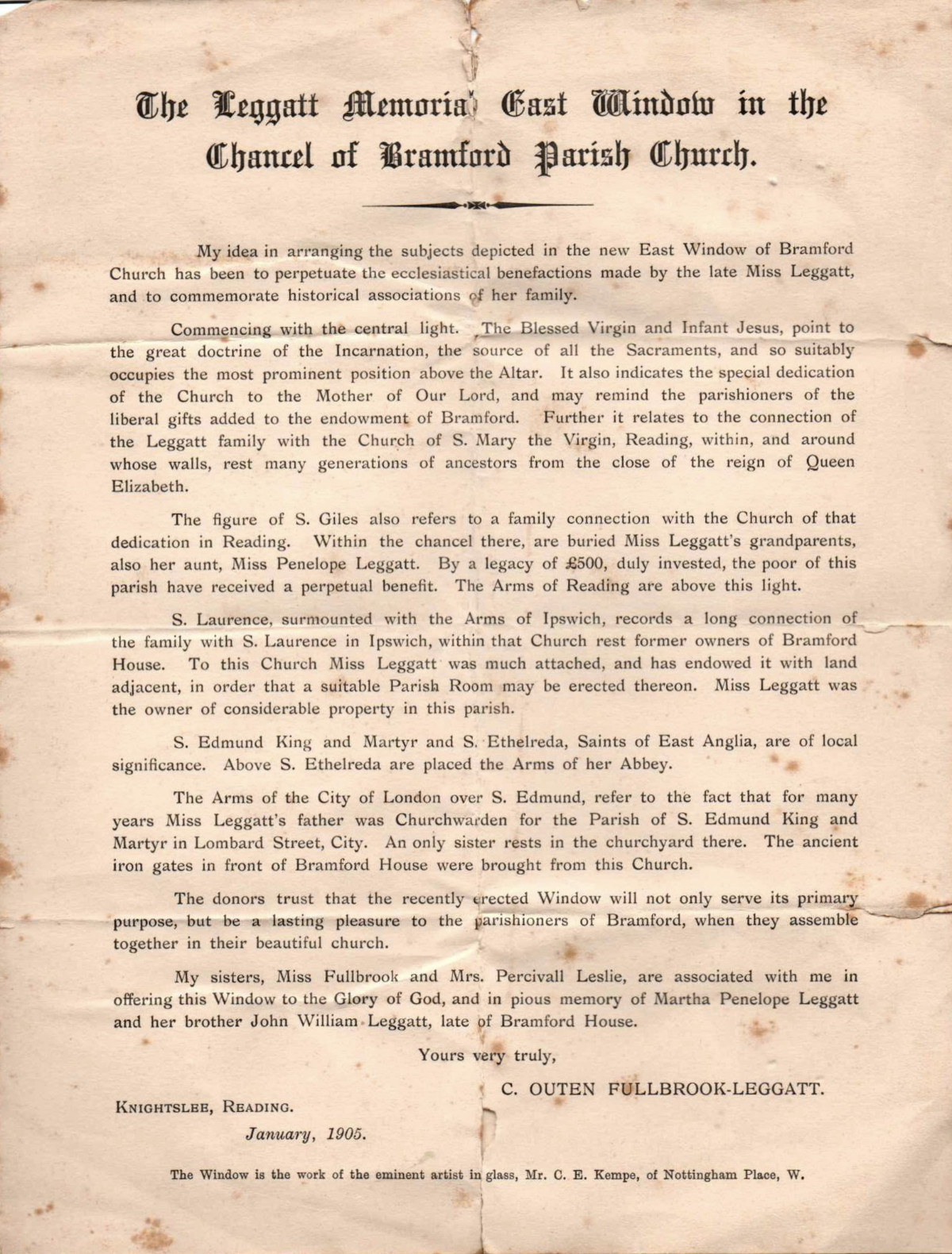
The memorial east window, which since completion has been the centre of much admiration, is divided into five lights, on each being depicted a figure, worked out in exquisite colouring. The central light, which occupies the most prominent position above the altar, bears the figure of the Blessed Virgin and the Infant Jesus; this picture is appropriately chosen as representing whom the church is named after. The figure of St. Giles in the next light is selected in reference to the church of St. Giles at Reading, where many of the Leggatt’s are buried: the arms of Reading surmount this light. On the extreme right is St. Lawrence; the light surmounted with the arms of Ipswich, in token of the long connection of the family with this town. The two lights to the left of the window depict the two East Anglian Saints, St. Edmund and St. Etheldreda; above the latter saint are placed the arms of the great Abbey; the arms of the City of London over St. Edmund signify that for many years Miss Leggatt’s father was churchwarden at the church at St. Edmund, Lombard Street, London.
The window, which has been beautifully carried out in every particular, is the work of Messrs. Kemp, of London.
The paragraph in italics describing the layout of the window is wrong. The following is a corrected alternative wording:
“The memorial east window, which since completion has been the centre of much admiration, is divided into five lights, on each being depicted a figure, worked out in exquisite colouring. The central light, which occupies the most prominent position above the altar, bears the figure of the Blessed Virgin and the Infant Jesus; this picture is appropriately chosen as representing whom the church is named after. The figure of St. Giles (or St Egidius as he is named on the window) in the next light (to the right of the Virgin Mary) is selected in reference to the church of St. Giles at Reading, where many of the Leggatt’s are buried: the arms of Reading surmount this light. On the left of the Virgin Mary is St. Lawrence; the light surmounted with the arms of Ipswich, in token of the long connection of the family with this town. The two lights to the extreme left and extreme right of the window depict the two East Anglian Saints, St. Edmund (left) and St. Etheldreda (right); above the latter saint are placed the arms of the great Abbey (see Ely Cathedral)and the arms of the City of London over St. Edmund signify that for many years Miss Leggatt’s father was churchwarden at the church at St. Edmund, Lombard Street, London.”
A printed letter explaining the gift was published – probably for the congregation at the dedication service:
(Image kindly provided by Jenny Burgon)