
Edward Packard & Co Barges
From the first, the Orwell, to the last, the Trent River, Edward Packard & Co ran their steam barges on the Gipping between the Bramford Works and Ipswich Docks for over 60 years. Nick-named “Packard’s Navy” within the company, the skippers of these vessels were typically experienced mariners, usually assisted by a boy to stoke the boiler. Research has revealed some of the names of the barges and their skippers.
The Orwell – the first steam barge built by Edward Packard
Edward Packard ran a trial of his first steam barge in 1868 as described in this article.
Ipswich Journal 20th June 1868 STEAM ON THE GIPPING.—Messrs. E. Packard & Co.’s new steam barge, which we noticed a fortnight since as intended for the traffic between the works of the firm at Ipswich and Bramford, had a trial on Thursday, and though the arrangements of the engines are not entirely complete the trial was satisfactory. The barge, with half a load on board, on leaving the dock first steamed down the cut, and several trials of her speed were taken. With the twin screws by which she is propelled making 140 revolutions a minute, her speed was 3¼ knots an hour; at 164 revolutions it was 4 knots at 208 revolutions 4½ knots, and half speed 2½ knots, and at 220 revolutions, going against the wind and with no tide running, the barge went at the rate of 51/8 knots. With one screw going full and the other half speed ahead a complete circle was made in about two lengths of the barge in one minute three seconds. At half-past 10, high water, she started on her voyage up the Gipping and arrived safely at the Bramford works where she discharged her load and took another half load with which she returned, reaching the lock gates to Ipswich dock at high water at night. The canal was found to be very shallow in some parts, and the progress of the barge was a good deal impeded in consequence. Some apprehension had existed lest the screws should become choked with weeds, but it was found that though the weeds got twisted round the screws to a considerable extent, their working was not interfered with. On her journeys up and down the Gipping it is expected that the “Orwell”, as the barge is named, will carry a load about 25 tons, but in deep water admitting a draught of four feet she will carry from 50 to 60 tons. When the engines are thoroughly finished another trial will be made down the Orwell and out to sea.
The Clyde – Steam Barge
East Anglian Daily Times 27th December 1902 FIRE ON A STEAM BARGE. At a few minutes before six o’clock on Friday morning, one of the men in the employ of Ipswich Dock Commission observed smoke issuing from the steam barge Clyde, belonging to Messrs. E. Packard and Co., which was lying in the Dock, near the Gas Works, alongside the trading ship Christientine (Swedish), ready to discharge her cargo of special manure (superphosphate). The Commissioners’ man ran round, and gave the alarm to the crew of the Christientine, and sent a messenger named Cowling to the Fire Brigade Station. Supt. Wheeler, realising, from the nature of the message, that the big ship was in danger, turned out in full force, with steamer, hose reel, and implement cart, and found upon arrival that the Clyde was well alight in the after part, and that the side of the ship was very hot. A line of hose, attached to the hydrant at the corner of Patteson Road, was taken over the ship and down a ladder onto the burning barge, and was kept at work till the fire was sufficiently subdued to enable the firemen to shift the barge from alongside the ship to the Quay, when the hydrant was again got to work, and the fire was extinguished. No cause can be assigned for the fire. It appears the barge was moored alongside the ship on the night of Christmas Eve, when the man in charge (Mr. B. Warner) left her, after bringing her from Bramford, and, so far as he knows, no one boarded her till the firemen arrived. As the result of the fire, the whole of the after part of the vessel, including the engine-room, stoke-hold, and coal bunkers, was burned out, and the deck was burnt off. The cargo of valuable manure, though saved from the fire, was somewhat damaged by water, but an excellent stop was made, and no doubt the energies of the firemen saved the big ship whose side was scorched, from destruction. The steam fire engine stood by with steam up, but, the hydrant proving equal to the work, it was not used. Notes: 1901 Census – Benjamin C Warner, General Labourer at Manure works Age 22 living in Nelson Road Ipswich. Wife Mary A [Hardwick] (22) born Bramford 1911 Census as 1901, but now a Bargeman Mary Ann Hardwick was the daughter of John and Emily Hardwick of Runcton
The Mersey – Steam Barge

The Mersey steaming upstream near Riverside Road, Ipswich

A close-up showing the name plate
Ipswich Journal – 27th December 1873 DEATH BY SUFFOCATION ON BOARD A BARGE. — An inquest was held at the White Elm, Bramford, on Wednesday, on the body of Joseph Pead, a very steady and well-conducted young man, employed as stoker on board Mr. Packard’s steam barge Mersey. He was last seen alive on Wednesday morning, at half-past seven o’clock, by William Pegg, a bricklayer, who saw deceased look out of the forecastle hatch and then draw the hatch over. David Addison, a master of one of Mr. Packard’s barges, went on board at half-past eleven o’clock, thinking that deceased had overslept himself, and found the hatch nearly closed, and deceased lying on the cabin floor, quite dead. When the hatch was closed there was no other means of ventilation for the forecastle. Mr. W. H. Meadows, surgeon, said deceased was a stout, fat, short-necked person, and in his opinion death was caused by apoplexy. A want of ventilation would intensify the tendency to apoplexy, and he (Mr. Meadows) was of opinion that there were no more than 100 cubic feet of space in the cabin. The Jury returned a verdict of ” Death from natural causes.” Notes: Joseph Pead was born in 1854 in Ipswich and in 1871 lived at 35 Hamlet, St Clements with his widowed mother and four siblings. He was working as a porter in 1871. William Pegg was born in 1852 in Ipswich and lived at 64 Wykes Bishops Street, St Clements. He worked as a stone mason in the 1871 Census. David Addison was born in 1829 in Woolverstone. He lived at 46 Princes Street, Ipswich (St Clements Parish) and was a “Mariner” in the 1861, 1871 and1881 Census’s. In 1891 he was a General Labourer and “River bargeman” in 1901. He was prosecuted for larceny in 1874, for stealing a bag of lead from Edward Packard & Co, hiding it on his barge. He was given three months in prison. In 1911 he is living with his son at 2 Durham Villas, Felixstowe Road, Ipswich age 81. He died in1913.
Ipswich Journal – 3rd February 1877 ACCIDENTS, &c Another melancholy incident of the high tide was that of a rather serious accident to a lad named Edward West, whose parents reside in Myrtle Road, St Clement’s. It appears that he was coming down from Bramford on one of Messr’s Packards barges and when near Stoke Bridge the barge was compelled to wait until the tide receded sufficiently to allow of her passing under the bridge. Whilst making her way under, and steering for the centre of the arch the tide set the barge upon the side of the same, wrenching the lowered funnel, and also the safety valve attached to the top of a portable boiler, from their positions. The safety valve, or steam chest attached to the same, pulled away the bolt holes, and otherwise injured the boiler and pipes in connection with it. Steam and water at once rushed out, and the lad West, who was in the stoke hole, was very severely scalded, the flesh hanging in shreds on his hands, and his face presenting a horrifying spectacle. The master of the barge, Webb (who also drives the engine), was knocked overboard by the tiller striking him, and holding on to the timber heads, was rescued with no more than a ducking, although he narrowly escaped being scalded. Mr Meek (lockmaster) and an assistant named Giles had gone up the river to meet the overdue barge and probably escaped serious injury by being unable to get aboard her. The injured lad was at once removed to the Hospital where his injuries have been attended to. He now lies in an almost unconscious state.
East Anglian Daily Times – 20th February 1877 In a later article it was reported that Edward Crane West, age 16, died of his injuries on the 17th February. At the Inquest the barge concerned was named as the Mersey belonging to Edward Packard & Co. At the time of the accident, it was towing the dumb barge Thames.
The Stour – Steam Barge

The Stour at the Bramford Works

The Stour towing dumb barges upstream near Riverside Road Ipswich
This article mentions that the Stour was used by the Navigation Commissioners and Trustees for their annual inspection of the river.
East Anglian Daily Times – 24 August 1908
SULPHURIC ACID IN THE
GIPPING.
APPEAL TO THE BOARD OF AGRICULTURE.
Although for reasons which need not to be specified, the public does not make as much use of the river Gipping as the Stowmarket Navigation Company would like, and there is practically no traffic at all above Bramford, the Commissioners and Trustees are compelled by the terms of their charter to make an annual inspection of their fifteen miles of river. This function took place on Saturday.
Owing to the dry weather, there was not enough water in the Stowmarket district of the river to carry the steam barge Stour, lent by Edward Packard and Co, Limited, of Bramford, which was used for the inspection. A start was made, therefore, at the Bosmere Lock, below Needham Market, at about half-past ten. The following gentlemen composed the party:- Mr, F W Dudding, Mr. C. C. Tuck. Mr. C Marriott, Rev H Carter, Mr. R H Lingwood (Trustees) Mr. H. C. Gooding, Mr. W. Turner (Commissioners) Mr. H. Miller (Engineer), Mr P C G Hayward (clerk) and three or four visitors. A large number of letters of apology for absence were received.
Favoured by fine weather, with the exception of one short shower, the inspection made a very pleasurable day for those who participated in it. All locks were found to be in good order, and the water was generally clear and of sufficient depth for ordinary barge traffic. The weeds were cut earlier in the Summer. Plenty of fish were noticed, and a particularly fine shoal of bream at Blakenham attracted a good deal of attention from the fishing members of the party. The catering was well done by Mr J C Gray, of the Kings Head, Stowmarket.
During the afternoon a meeting of the Trustees was held on board and the subject of the pollution of the river and consequent danger to cattle and death of fish was considered, on a letter which had been received. It was resolved to report the matter to the Board of Agriculture, a specific case which occurred on the 3rd ult. being cited. A large quantity of fish, it was stated, were killed, and samples of water taken by a chemist at Needham Market were found to contain sulphuric acid. “It is presumed” the letter stated, “that the poisonous matter was introduced into the river at Stowmarket, where there are gun-cotton, cordite, and other chemical works.” The letter has been widely signed by riparian owners and occupiers, and it is hoped that an inquiry into all the circumstances will be held.
The Trent River – Steam barge

The Trent River heading upstream from Bramford Lock
In the July 1933 edition of the Fison, Packard & Prentice Journal, William Hitchcock – manager of the Bramford Works – wrote about the retirement of barge skipper George Glading. In it he stated that the Trent River was built in 1916. It was the last barge operated by the company which by then relied on rail and road transport. George Glading took the barge on (it is said it was gifted to him as a retirement present) and continued working in his own right offering towing and lighterage services at Ipswich docks and on the Orwell River.
The Tyne – Steam barge (Edward Packard & Co)
Evening Star – 9th July 1898
The discovery of a body in the Gipping, by the crew of the Tyne, was reported in the paper – it stated that the barge belonged to Edward Packard & Co.
Evening Star – 12th July 1898
A following article reported on an inquest on the man, Charles Smith. The report states that; “William Sporle, barge captain on the Tyne, said that about 4 o’clock on Saturday morning he found the deceased body entangled in the propellor of his barge near the tide lock on the Gipping.”
DUMB BARGES
All the barges run by Packard’s were named after British rivers and this included the “dumb” barges, or lighters, that were towed behind the steam powered boats. A helmsman would steer the dumb barges. A few have been mentioned in news reports or identified from postcard pictures.
The Thames – Dumb Barge
See reference in Mersey above. The barge was mentioned in an article about the death of David Pinner in 1909
East Anglian Daily Times 3rd March 1909
In the article about the inquest into the death of David Pinner he was described as having “…had charge of Messrs Packard & Co’s barge Thames…” at Ipswich Docks when he fell into the water. Although rescued, he died later- the cause of death was thought to be from the effects of the immersion. He was 66 years old and had pre-existing health problems. In census records David Pinner is described as a “Bargeman” (see also Fisons barge Scorpion)
The Severn – Dumb barge

The Severn being towed downstream under Bramford Bridge.
This picture would have been taken after 1903 when the bridge had been rebuilt.
The Yare – Dumb barge

Almost certainly this is the only barge to survive today from the fleet operated by Edward Packard & Co.
At the end of its working life, in 1933, it was moored at Pin Mill and converted into a houseboat. A local artist, Jack Haste, bought it in 1953 and used it as his studio.
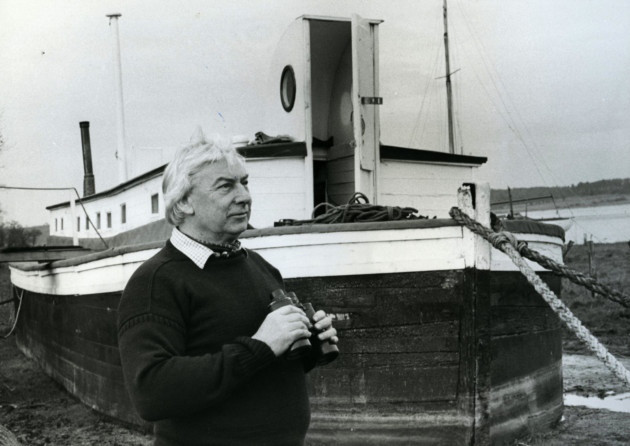
Jack Haste and the Yare in 1989
When Jack died in 2014 the barge was put up for auction and sold in 2015. Its houseboat superstructure was removed, and it was decked over to be used as a mooring pontoon for the static Dutch motor barge Adelaar – currently used as holiday accommodation.
Full details can be found on the Historic Ships Register (NB the register has not been updated with the latest status of the Yare) https://www.nationalhistoricships.org.uk/register/1875/yare
Building barges at Bramford
An extract from a newspaper report of the visit of the Ipswich Science Gossip Society to Packard’s Works in Bramford – Ipswich Journal 18th May 1872:
“On the Banks of the Gipping, barges are built and repaired, and a very fine barge has only recently been launched. Another is now upon the slip, and is undergoing rather extensive repairs. These vessels carry about 40 tons, and are worked by steam; a screw barge taking one or more others in tow.”
Joseph Fison & Co Barges
Joseph Fison’s factory had greater access to the river than Packard’s and it is clear, from the nature of the buildings on the waterside, that they must have used this method of transport for their materials.
This aerial photograph of the Bramford site was published in a Fison, Packard & Prentice promotional brochure following the completion of the new superphosphate factory on Cliff Quay, Ipswich, in 1933.

Although barge traffic had stopped and the factories had amalgamated (in 1929), the waterside range of buildings of the Joseph Fison & Co factory are identifiable. “Lucams” can be seen on two of the warehouses – a lucam is a projecting gable or dormer for external hoisting on a watermill or other building. Another aerial photo taken in 1921 (before the amalgamation) clearly shows barges under the lucams (https://www.britainfromabove.org.uk/en – search “Bramford”).
In all the research carried out in the newspaper archives and old postcard images no steam barges belonging to Joseph Fison & Co have been identified.
However, three references to horsedrawn barges and one other have been found:
Unnamed Horsedrawn barge
Ipswich Journal – 16th January 1869
On Monday afternoon an accident occurred to a horse engaged in drawing a new barge, the property of Mr Joseph Fison, to his manure works at Bramford. The horse was in charge of a boy, and the barge of a man named Chamberlain. When near the Chauntry Lock upon the Gipping the horse swooned and fell into the ditch by the side of the river. It was got out alive but soon afterwards died.
This “new” barge may have been the Scorpion:
The Scorpion – Horsedrawn Barge
The Ipswich Journal – 5th February 1870
Report on an inquest into the drowning of Edward Abbott, bargeman.
In the report David Pinner (see also references to him under Edward Packard’s barges) stated he was captain of the barge Scorpion which “… plyed between Ipswich and Mr Fison’s manure manufactory at Bramford.”
Edward Abbott was the horse leader and had fallen into the river at the bridge near Ipswich Railway Station.
The barge was carrying a load of coprolite from Fison’s mill at Halifax (on Wherstead Road).
East Anglian Daily Times – Wednesday 29 March 1876
A FALL OVERBOARD – On Monday night a man named Burman, an occasional hand on board Mr Fison’s barges, fell overboard from the barge Scorpion when passing through the locks at the entrance to the Stowmarket Navigation. The only ill effects he experienced were those resulting from a thorough drenching.
The Dragon – Barge
The Dragon has been found mentioned twice in newspaper reports:
East Anglian Daily Times 10th February 1872
A DUCKING – As Captain Pinner, of the barge Dragon, belonging to Mr Fison was passing Bramford Locks on Thursday morning, he fell overboard, but fortunately sustained no more unpleasant consequences than a thorough ducking.
Ipswich Journal – 11th January 1873
MISHAP AT THE LOCK-GATES – A slight mishap occurred yesterday (Friday) morning at the Lock-gates. Some barges, one of which, the Dragon, belongs to Mr Fison, were passing through the lock basin, and the captain went below to put his oilskin on (it rained in torrents at the time), and not thinking of the position of his rudder, it was in his absence unshipped by grating against the walls, and being iron it went to the bottom.
No indication given whether it was horsedrawn, under its own power or being towed.
Unnamed Horsedrawn barge
Evening Star – 7th April 1898
In a report about of the body of a man being found in the river near the Ipswich Tannery it says that the discovery was made as “…One of Messrs. J Fison and Co’s barges was being towed by a horse from Bramford in the direction of Ipswich and had on board two named David Pinner, of 3 Baker Street and Harry Laflin residing at Westbourne, Norwich Road…”
Fison and Packard – possible cooperation?
The recollections of Richard N Wolton were published in the Fisons Journal – Christmas 1957 edition.
Richard’s father, William, was a manager for Joseph Fison in the late 19th and early 20th Centuries. It was natural for Richard to follow him into the company, and he eventually ended up in charge of Fison’s interests in South Africa. In the article Richard recalled a voyage on one of Joseph Fison’s sailing barges, the Memory.
“The voyage which I intend to describe took place in the summer of 1913. For many weeks prior to this I had witnessed, at Bramford, the careful preparation of the consignment of fertilizers for South Africa. The whole consignment was shovelled through a builders screen many times before it was in satisfactory condition for packing for its long voyage”.
After careful preparation the consignment was loaded into barges for transportation, down the Gipping, to Ipswich Docks:
“Our consignment filled the steam barge and also two lighters which were towed to the Ipswich Docks, where “Memory” awaited it. The steam barge was captained by John Hall, whose responsibility it was to get the consignment safely through the numerous lock gates, and the hazards of the Gipping to Ipswich. I remember we grounded more than once and great was the effort needed to get afloat again.”
After transfer into the sailing barge, Memory, Richard then continues the story of the voyage to London where the cargo was trans-shipped for its South African destination.
The mention of the steam barge and its captain, John Halls, is interesting. No detail of the name of the steam barge is provided but John Halls was known to have been employed by Edward Packard & Co.
Ipswich Journal 23 May 1871
A NARROW ESCAPE – On Friday, John Halls, master of Mr Packard’s steam barge Orwell, had a narrow escape from drowning. It appears that the craft was on her passage from Bramford to Ipswich, and some part of the machinery gave way, and in order to reach home, Halls rigged up a sail by placing up a tarpaulin, and by some cause or other the mast fell, and Halls went overboard when near Stoke Bridge. Halls was no swimmer, but fortunately for him on his appearance from under water, he managed to grapple a portion of the craft, and was saved from his unenviable position.
In 1861 John Halls (born 1839) was described as a “mariner in the merchant service”, in 1871 “Master on a steam barge” and in 1911 a “Steam Barge Driver River Boat – Chemical Manufacturer”.
It is possible, of course, that he could have worked on a freelance basis for both Fison and Packard but the lack of evidence that Fisons ran their own steam barges is compelling. The working theory is that Fisons used Packards services even though they were in competition with each other. Although Fison’s were still using horsedrawn barges in 1898 (see above) it seems unlikely that they would have continued this method into the 20th century. If they had, it would have been quite notable and very likely the subject of Edwardian photographers and/or news reports.
The fact that the companies operated next door to each other must suggest that some degree of cooperation developed over the years.
Unnamed Fison’s Barges
Ipswich Journal 11th April 1896
In a report on the drowning of Walter Robertson: “… as some of Messrs. Fison’s barges were proceeding along the Gipping near the Chantry Locks, one of the crew noticed the body of a man in the water…”
No details were given of how the barges were powered or crew names.
Amazing, Informative and Enjoyable Account.